
Payments on Big Mumbai Plus – Secure, Transparent, and User-Focused Payment Experience
Introduction to the Payments System on Big Mumbai Plus
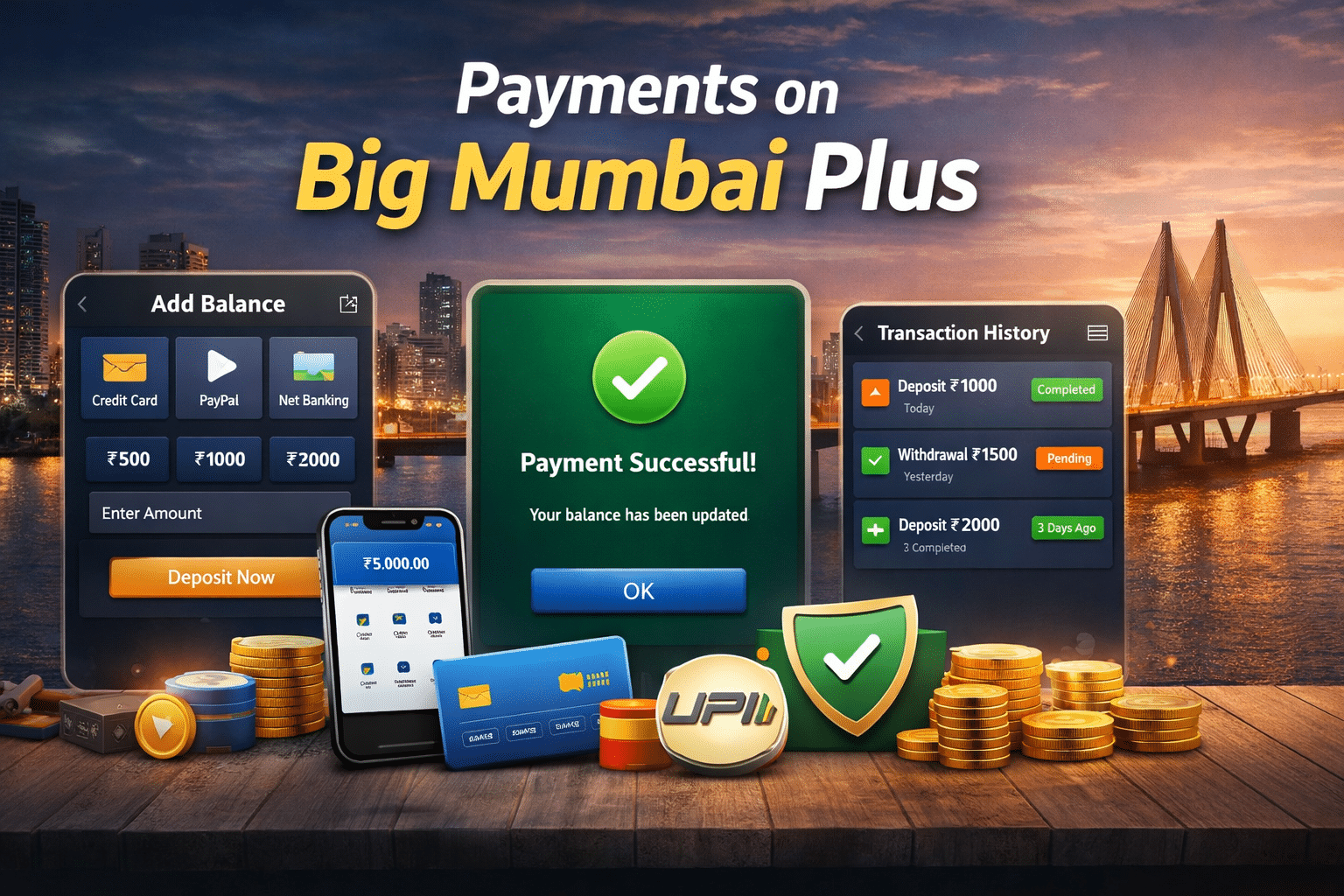
Payments play a central role in how users interact with any modern digital entertainment platform. On Big Mumbai Plus, the payments section is designed not as a financial service, but as a structured informational layer that demonstrates how payment interfaces, transaction flows, and account balances are typically presented in contemporary platforms.
This Payments page is created for UI/UX reference, educational insight, and interface exploration purposes only. It helps users understand how a payment system is visually organized, how information is displayed, and how user actions are guided through a clear and logical process.
Big Mumbai Plus does not process real-money transactions, does not provide gambling or financial services, and does not act as a payment provider. All payment-related content is presented in a demo and informational context, allowing users, designers, and researchers to explore structure and layout without real-world financial involvement.
Purpose of the Payments Page
The Payments section on Big Mumbai Plus serves several key purposes:
-
Demonstrating payment interface design
-
Showcasing transaction flow structure
-
Explaining status indicators and confirmation logic
-
Presenting user-friendly balance and history layouts
-
Supporting UX research and content analysis
Instead of focusing on monetary value, this page emphasizes clarity, transparency, and usability. Every element is arranged to help users quickly understand where to look, what action to take, and how the system responds.
Core Principles of the Big Mumbai Plus Payment Interface
Transparency by Design
Transparency is the foundation of the payment layout. Every screen is structured so that users can easily see:
-
Selected action (deposit, withdrawal, history view)
-
Current balance display
-
Transaction status indicators
-
Time and reference information
There are no hidden steps, confusing pop-ups, or unclear confirmations. Each action follows a linear and predictable flow, reducing user confusion and cognitive load.
Simple and Logical Navigation
The Payments page follows a hierarchical navigation structure, usually divided into:
-
Payment Overview
-
Add Balance (Demo)
-
Withdraw Balance (Demo)
-
Transaction History
-
Payment Status
This organization mirrors common industry patterns, making the interface instantly familiar even to first-time users.
Consistent Visual Language
Consistency across the interface ensures that users do not need to relearn interactions on each screen. This includes:
-
Unified button styles
-
Consistent color usage for status labels
-
Repeated layout patterns for forms and summaries
-
Standard icon placement for guidance and confirmation
This design consistency improves usability and reduces interaction friction.
Payment Overview Section

The Payment Overview acts as the central dashboard of the system. It typically displays:
-
Current demo balance
-
Recent transaction summary
-
Shortcut buttons to common actions
-
System notifications or informational messages
The goal of this overview is to give users a quick snapshot of their payment-related activity without overwhelming them with details.
Add Balance Interface (Demo Presentation)
Structured Input Flow
The Add Balance screen demonstrates how platforms typically guide users through a structured input process:
Select a payment method (visual icons or cards)
Enter or select a predefined amount
Review transaction details
Confirm action
View confirmation status
Each step is clearly separated, preventing accidental actions and improving comprehension.
Visual Clarity in Amount Selection
Amounts are usually presented as:
-
Predefined selectable values
-
Manual input field with validation
-
Clear formatting for numbers and currency indicators
This layout helps users understand scale and avoid errors, even in a demo environment.
Confirmation and Feedback
Once an action is submitted, the system demonstrates instant feedback through:
-
Loading indicators
-
Success or pending status labels
-
Confirmation messages
-
Visual checkmarks or icons
Immediate feedback reassures users that their action has been registered.
Withdraw Balance Interface (Demo Presentation)
The Withdraw Balance section mirrors the Add Balance layout to maintain consistency. Users can observe:
-
Destination selection layout
-
Amount input structure
-
Review and confirmation screen
-
Status display after submission
This symmetry between deposit and withdrawal screens reinforces familiarity and reduces learning time.
Emphasis on User Awareness
Before confirmation, the interface highlights:
-
Entered amount
-
Destination details
-
Estimated processing status
-
Informational notices
This ensures users clearly understand what they are about to do before proceeding.
Transaction History Layout
Transaction History is a critical informational component. On Big Mumbai Plus, it is designed to be clean, readable, and sortable.
Common Elements in the History Table
-
Date and time
-
Transaction type
-
Reference or ID
-
Status indicator
-
Amount display
Rows are spaced clearly, with subtle separators to avoid visual clutter.
Status Indicators and Labels
Transaction statuses are displayed using:
-
Text labels (Completed, Pending, Cancelled)
-
Color-coded indicators
-
Small icons for quick recognition
This allows users to scan history entries quickly without reading every detail.
Payment Status and Notifications

The Payment Status system demonstrates how platforms communicate progress and results to users.
Types of Status Messages
-
Action successful
-
Action pending
-
Action requires attention
-
Informational notice
Messages are written in simple language and placed near the relevant action area to maintain context.
Non-Intrusive Alerts
Instead of disruptive pop-ups, the interface favors:
-
Inline notifications
-
Top banner messages
-
Highlighted sections
This approach keeps users informed without interrupting their navigation flow.
Security-Oriented Interface Design
Although Big Mumbai Plus does not process real payments, the UI demonstrates best practices for secure design, including:
-
Masked input fields
-
Clear confirmation steps
-
No automatic submissions
-
Visual separation of sensitive areas
These elements help users understand how secure platforms typically protect user actions and information.
Mobile Responsiveness and Accessibility
The Payments interface is optimized for multiple screen sizes.
Mobile Design Considerations
-
Stacked layout for smaller screens
-
Large tap-friendly buttons
-
Readable font sizes
-
Collapsible sections for history lists
This ensures a consistent experience across desktop, tablet, and mobile devices.
Accessibility Features
The design emphasizes:
-
High contrast text
-
Clear labeling
-
Logical tab order
-
Descriptive button text
These features make the interface accessible to a wider range of users.
Educational and Demonstration Value
The Payments page on Big Mumbai Plus is particularly useful for:
-
UI/UX designers studying payment flows
-
SEO professionals analyzing structure
-
Developers exploring layout patterns
-
Users learning how digital platforms organize payments
All content is created with educational clarity in mind, avoiding misleading claims or real-world financial instructions.
Informational Disclaimer for Payments Content

All payment-related content on Big Mumbai Plus is provided strictly for informational and demonstration purposes.
-
No real-money transactions are conducted
-
No financial services are offered
-
No payment processing is performed
-
No rewards or monetary value are involved
Users are encouraged to view this content as a visual and structural reference only.
SEO and Content Structure Advantages
From an SEO perspective, the Payments page is structured to ensure:
-
Clear heading hierarchy (H1–H3)
-
Semantic keyword usage
-
Logical content flow
-
Clean formatting without errors
-
Informational intent alignment
This structure helps search engines understand the page purpose while providing genuine value to readers.
Why a Well-Designed Payments Page Matters
Even in demo environments, payment pages influence user trust and perception. A clear and professional design:
-
Builds credibility
-
Reduces confusion
-
Improves engagement
-
Enhances overall platform experience
Big Mumbai Plus reflects these principles through a clean, transparent, and educational payment interface.
Future-Oriented Design Approach
The Payments layout on Big Mumbai Plus is designed to be scalable and adaptable, allowing future enhancements such as:
-
Additional informational modules
-
Expanded UI demonstrations
-
Comparative layout examples
-
Deeper UX explanations
This forward-thinking approach ensures long-term relevance.
Conclusion
The Payments section on Big Mumbai Plus is a comprehensive demonstration of modern payment interface design, focused on clarity, structure, and user understanding. Rather than offering financial functionality, it provides a valuable reference for how payment systems are visually and logically organized in today’s digital platforms.
With transparent layouts, consistent navigation, clear status indicators, and a strong emphasis on user experience, the Payments page fulfills its role as an informational, educational, and UI-focused resource.
Big Mumbai Plus continues to prioritize responsible content presentation, ensuring that users can explore, analyze, and learn from digital payment interfaces in a safe and non-transactional environment.